Showing posts with label music. Show all posts

Wednesday, April 04, 2007

Mecha vs. Kaiju: The Soundtrack


I've found, thanks to SciFi Weekly, a new entry in the giant monster music collection. Stratos plays electronica and his new concept album is all about a battle between giant robots and giant monsters. Electronica isn't usually my thing, however, the bits of "Mecha vs. Kaiju" I've heard off Stratos's MySpace page and from the samples of the album itself sound pretty good and worth a try.

Stratos was involved in another recent project I don't think I've mentioned: Kaijuice. You can read SciFi Weekly's review of that, or check out their Web site. Among the bands on that disc is one I've mentioned before, surf punk band Daikaiju. So at least some of it should be good.

Thursday, February 09, 2006

Akira Ifukube, 1914-2006


Horrible news, Godzilla music composer Akira Ifukube has died. Ifukube was one of the three people who were the heart of Godzilla, along with director Ishiro Honda and special effects director Eiji Tsubaraya. In fact, Ifukube was Godzilla's voice. It was his idea to run a metal glove down a bass string that created the distinctive sound of G's roar.

Even people who don't know about who scored the Godzilla films intuitively know Ifukube. When you hear those first bass notes of Godzilla's theme, you know the giant monster is about to arrive. For me, his themes for the movements of the military and the actions of the heroes always cheer me up. They are march songs, stirring and moving. I could listen to them at any time.

Here's what Steve Ryfle says about Ifukube in his book "Japan's Favorite Mon-Star" (which is a classic book about Godzilla, a must read):

A KAIJU CACOPHONY: The illusion of Godzilla's size and irrefutable power was reinforced by the thundering sounds of Akira Ifukube, who wrote one of the most memorable musical scores in sci-fi movie history and who supervised the creation of Godzilla's distinctive, immortal roar. Despite his background in classical music and as a composer of serious dramatic films, Ifukube never shied away from [G producer Tomoyuki] Tanaka's oddball monster movie, not even when his contemporaries said it was beneath him and urged him not to do it. After just a few introductory meetings with Tanaka, Tsuburaya, and Honda to discuss the project, Ifukube enthusiastically accepted the assignment. "Something monstrous comes out and makes you jump out of your wits!" Ifukube said. "It is sheer fear, not an abstraction, and it is global. Moreover, my specialty was biology. [Ifukube had worked in forestry.] I couldn't sit still when I heard that in this movie the main character was a reptile that would be rampaging through the city."

Ifukube also did work outside of the Godzilla films, from science fiction spectacular's like The Mysterians and Atragon to samurai classics such as they Zatoichi series. For a listing of his work, check out The Akira Ifukube Page.

It is less well known that Ifukube was an accomplished classical composer. His Japanese Rhapsody won a prestigious international prize and was first performed in 1936 by the Boston People's Orchestra.

Here's an interesting passage from David Kalat's "A Critical History and Filmography of Toho's Godzilla Series":

Ifukube's compositional style, which creates music with distinctly Asian qualities whileusing the instruments of traditiona European classical music, is one of emotional extremes and operatic values. During World War II, the Japanese military commissioned him to compose nationalistic hymns for the Pacific islands the Japanese "liberated" from the white people. Ironically, when General Douglas MacArthur arrived at Atsugi Air Force Base in August 1945 at the end of the war, the band performed Ifukubes brass band march for the Filipino people, much to Ifukube's surprise.
...
At the peak of his career, Ifukube scored as many as fifteen films per year, eventually scoring more than two hundred features. Ifukube's themes would make an indelible mark on listeners and would be used frequently over forty years, although ironically, he composed the Gojira soundtrack in under a week, without having seen any of the footage. Ifukube simply relied on Honda's assertion that Godzilla would be "one of the biggest things ever on the screen."
There's a lot more about him in Kalat's book, another essential text for Godzilla fans. You can also find information on Ifukube on Wikipedia. Tim Lucas writes a well thought out piece on the composer here.

Celebrate the man's life by picking up the King Kong vs. Godzilla soundtrack, one of the soundtracks he was most proud of. (And it's always been a crime that his music was taken out of the American version of the film.) Also, check out this Amazon Listmania! for what Ifukube music is available.

This also marks the end of an era. Ifukube was the only one of the creative masters behind the original Gojira who lived past its 50th anniversary. With the composer's passing, the creators of Godzilla pass into history. Long may their work live on.

UPDATE: Picture of Ifukube found at Tokyo Monsters.

Friday, January 27, 2006

Monster music

I recently got an iPod, so I went searching for giant monster music on iTunes. It was a quick search, but I came up with a few things, besides soundtracks.

First of all, there is a surf rock/metal band called Daikaiju. I've been aware of them for a little while now and they seemed like great fun. I downloaded two songs from their self-titled album: "Super X-9" and "Daikaiju Die!" It's great stuff. The band is kind of interesting too. They wear kabuki masks and all their press materials sounds like words translated from Japanese by an Internet translator.

The second thing I found was a podcast by Infinite Sector Collective.

The infinite sector is a non-profit collective and netlabel dedicated to sharing and promoting free experimental music, noise, and electronica. Our members include musicians, bands, and artists from all corners of the globe.
In honor of 50 years of Godzilla, their first podcast episode is dedicated to kaiju eiga. So members of the collective do songs about Rodan, Hedorah, Biollante and others. Most of it is very experimental. If you like static and Metal Machine Music, you might like this. I like a lot of weird music, and I had a tough time with most of the songs. The song "Jet Jaguar," however, was more approachable than the rest of it. It was performed by the group Terminal Shock. The podcast is not for everyone, and clearly not intended to be, but check it out and see what it does for your ears.

I gave a search on iTunes for "kaiju" and came up with "Kaiju Babylon." It's a song by jazz guitarist Henry Kaiser. Like Infinite Sector Collective, it's experimental music, but I found it more fun. It was like some twisted combination of Sonny Sharrock and Spike Jones. I was happy to find Kaiser because I notice he has connections to other artists I like, such as Captain Beefheart, Richard Thompson, Sharrock, Bill Frisell and John Zorn, among others. And, apparently, he is a fan of giant monsters. He gives his praise to "Gamera: The Revenge of Iris" at his journal. (That just shows he has taste as well.)

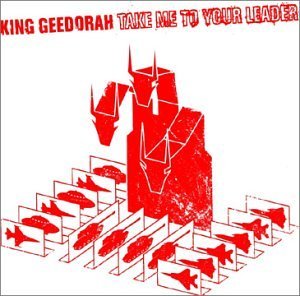
Finally, something I didn't find on iTunes, but wanted to mention: King Geedorah, "Take Me to Your Leader." King Geedorah is actually MF Doom, an underground hip hop artist who has gotten much praise for his purist stylings. The album is a lot of fun and can be enjoyed even by non-rap fans. Quite a few of the songs on the album are "instrumentals" made up of sounds and clips from giant monster movies. If you do like rap, there's some great work on the album as well. Some well known rappers are here, but hidden under giant monster pseudonyms. I recommend it.

While I'm at it, I'd like to remind everybody about The Monster Project, who I wrote about here.

Thursday, October 27, 2005

The Monster Project, a band

Check out The Monster Project, it's the Web site of a band that plays faithful versions of music from monster movies. Most interesting to people who come here would be "Kaiju Daisenso," the group's take on Akira Ifukube's Godzilla scores. There are samples of the music and it really is good.
Here's how the band describes itself:

An evolutionary offshoot of the New York City progressive art-rock collective, the Project presents creative but faithful rock arrangements of monster movie scores. Influenced by such ground-breaking acts as Fantômas, John Zorn and Mr. Bungle, the project's current songbook includes: Swan Lake, Act II Scene X (from Karloff's The Mummy and Lugosi's Dracula); The Slasher Suite (a medley of themes from A Nightmare on Elm Street, Friday the 13th and Halloween); and most significantly, an extensive survey of Godzilla music from 1954 to 1975 all from the original acclaimed composer, Akira Ifukube.


You can download the Godzilla music at these links: Godzilla Comes Ashore; Namikawa on Planet X; and Battle on Mt. Fuji. Enjoy.

UPDATE: For those in the New York area, The Monster Project will be appearing Wednesday, November 2, 2005 at 9:00 PM at
Knitting Factory
The Tap Bar
74 Leonard Street
New York, NY 10013
Tel: (212) 219-3132
http://www.knittingfactory.com/kfny/
Admission: $8.00
Write me if you go.

Monday, September 13, 2004

Godzilla vs. Sum 41

Monster Zero News informs us that "Godzilla: Final Wars" will feature a song by Sum 41.
This has increased some of the misgivings Godzilla fans are having about this movie. There was a lot of excitement about all these monsters and old ideas being thrown into this movie. But now, people are wondering, how can this movie work? It's starting to sound like it will be one big mess. I'm not prejudging, I'm looking forward to seeing what kind of monster mash Kitamura can pull off. But to have a pop-punk band attached to your Godzilla film before a composer is named, well that worries me.
UPDATE: Tokyo Monsters has an mp3 of Sum 41's song "We're All to Blame" in its media section. It's the song that will be used in "Godzilla Final Wars."

Tuesday, August 31, 2004

Godzilla (1954) soundtrack review

Filmtracks reviews the Godzilla soundtrack. They are quite complimentary, although the second review seems pretty uninformed to me.

Filmtracks Recommends:

Buy it... if you have any interest in Akira Ifukube or Gojira, for the 2004 album is the definitive release of the original film's music.

Avoid it... if you do not value the history of Gojira more than the need for perfect sound quality, or if the Ifukube style has proven too foreign for your Western sensibilities.


I have the soundtrack on now and it is better than I ever imagined. The couple of excerpts on "The Best of Godzilla 1954-1975" made me think it might be boring. It's anything but. It's a definite must have for any Godzilla fan.

Saturday, July 17, 2004

Godzilla soundtrack

The soundtrack for the original Godzilla movie is now available from pre-order from Lala Land Records. You know you want it. I'm ordering it right now. I was very happy with their special edition disc of "The Dark Crystal."